PowerBack Corporate Wellness

Your Pain Relief Coach

Welcome, your team.

This is your resource for preventing and resolving back and neck pain. It's built on the PowerBack Method by Dr. Raj Padalia — and provided to you as part of your company's corporate-wellness program.

Before you begin

Safety Check

This tool is designed for common mechanical back and neck pain. A small number of pain presentations require medical attention before any self-help exercises. Please read each item and check any that apply to you.

Safety check complete — you're clear to use this guide.

Medical disclaimer: This tool is provided by Dr. Raj Padalia, DPT, for educational purposes only and does not constitute medical advice, diagnosis, or treatment. It is designed for common mechanical back and neck pain in otherwise healthy adults. Always consult a physician before beginning any new exercise program. If you are unsure whether this guide applies to your situation, consult a licensed healthcare provider before proceeding.

Habit tool

Micro-Break Reminders

The more often you do the stretch, the faster the pain will resolve. When you are 2–3 days pain-free, you can wean off the stretches.

Reminders off

⏱ Time for a break!

Try one chin tuck and one standing backbend — 10 seconds each.

Treatment basics

How These Exercises Work

Patient Handout

The 3 Stages of Recovery from Pain

A plain-language explainer on why movement is the treatment for mechanical pain.

Open PDF ↗

The key signal to watch during every exercise session

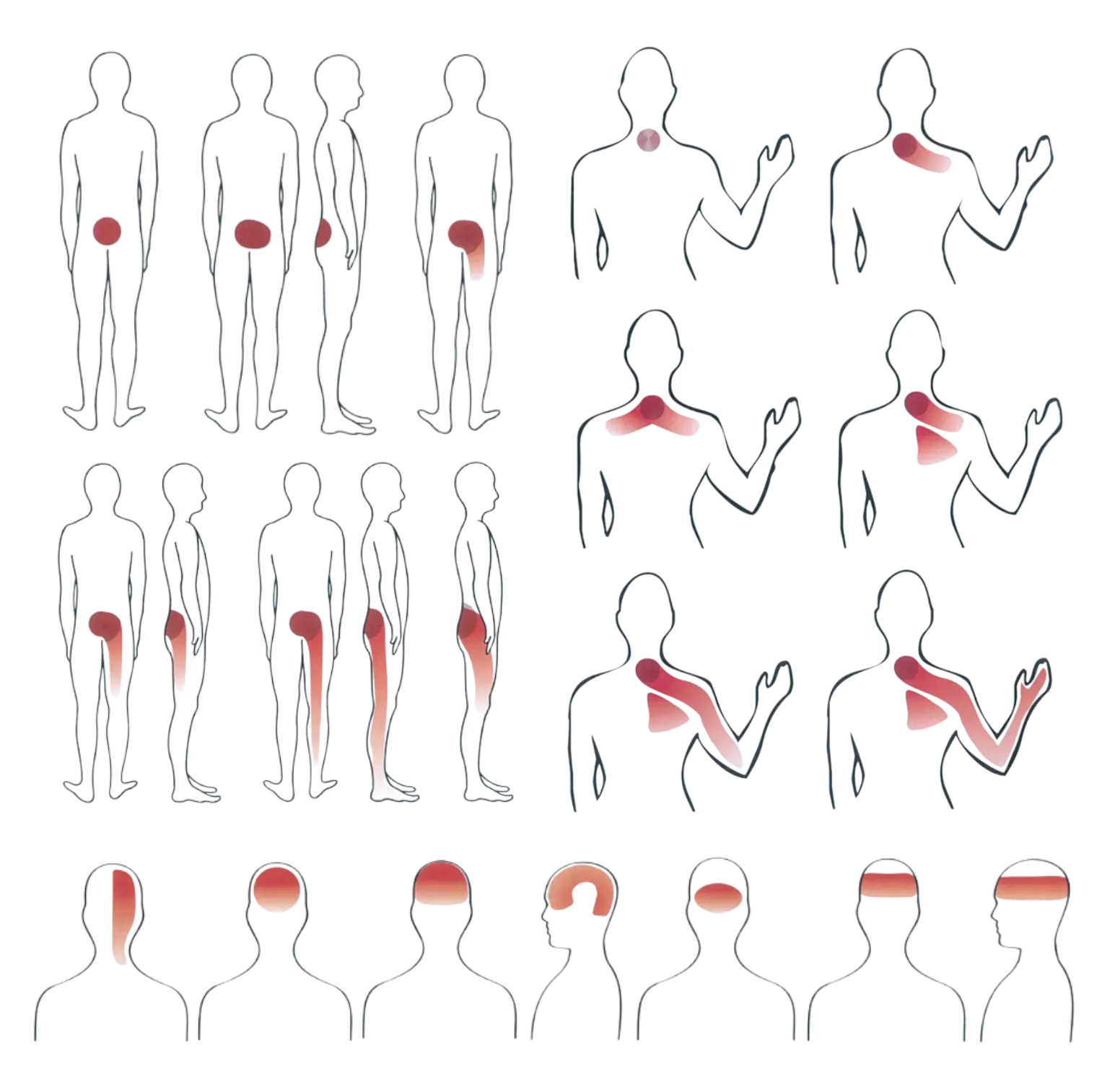
After each set, notice where your pain is located compared to before. This one observation tells you whether you're loading in the right direction.

Pain centralization and peripheralization diagram — left columns show back/leg pain moving toward the spine (improving) or spreading further (worsening); right columns show neck/arm pain doing the same; bottom row shows headache patterns
Centralizing = pain moves closer to your spine → you've found the right direction.   Peripheralizing = pain spreads further into the limb → stop and try a different direction.
  • ✅ Pain moving toward your spine (centralizing) → You've found your direction. Keep going.
  • ⚖️ No change in location → Neutral. Continue 2–3 more sessions and reassess.
  • ❌ Pain spreading further from your spine (peripheralizing) → Stop that exercise. Rest. Try a different direction, or see "When to See a Clinician."

Signs You're On Track

If you've found the right direction of treatment, you'll notice concrete changes within a few days. You're improving if any of these are true:

  • You can sit longer before pain returns (e.g., 10 min → 20 min)
  • Symptoms appear later in the day than they used to
  • Morning stiffness resolves faster
  • Pain that was in your leg or arm has moved back toward your spine
  • You need exercises less frequently to stay comfortable
Foundation

Main Stretch Routine

Perform this before and after you sit at a computer, lean over a counter, or perform lifting activities.

Perform this before and after you sit at a computer, lean over a counter, or perform lifting activities.

Low Back

The Press-Up

Extension in Lying

Lie face down, place your hands under your shoulders like a push-up. Straighten your arms and push your upper body up while keeping your hips and pelvis on the floor. Let your lower back sag and relax completely — don't tense your glutes.

Active recovery: ×10 reps · 6–8 sessions/day

⚠ Stop if leg pain or numbness spreads further down your leg during this exercise.

Standing Backbend

Extension in Standing

Stand with feet hip-width apart, place both hands on your lower back for support, and lean backward as far as comfortable. The portable version — ideal for desk micro-breaks, after long car trips, or whenever you can't get on the floor.

Maintenance: ×5–10 reps · 2–3 times daily · Also use for desk micro-breaks

Neck & Upper Back

Chin Tuck (Seated)

Retraction in Sitting

Sit tall. Tuck your chin straight back — like making a double chin — while keeping your eyes level. Don't tilt your head up or down. Hold 1 second, release. The foundational neck reset you can do anywhere, anytime.

×10 reps · Every 2 hours · Also do after any prolonged screen or phone use

Chin Tuck + Look Up

Retraction + Extension in Sitting

Start with a chin tuck (Exercise 1). From that tucked position, gently tilt your head back to look up at the ceiling. Adds extension to the retraction — the primary neck treatment movement. Add it once Exercise 1 is comfortable.

×6–10 reps · Every 2 hours · Add once Exercise 1 is comfortable

Seated Upper Back Backbend

Extension in Sitting

Sit upright. Lace your fingers behind your head and gently lean back, letting your upper back extend. Or simply clasp your hands and lift your arms overhead as you arch back. Do this at your desk every 2 hours — it directly addresses the forward rounding that develops alongside neck pain.

×10 reps · Every 2 hours · Pair with chin tuck exercises above

Posture

The Slouch-and-Straighten Technique

Slouch fully forward in your chair, then arch fully back to overcorrect — maximum curve in your low back. Then release about 10%. That end position is correct sitting posture. Repeat 10–15 times, 3–4 times a day for a few weeks to train the new position as a habit.

Do this whenever you catch yourself slouching — at your desk, in the car, on a sofa.

Lumbar Support Cushion

A firm, cylindrical cushion placed at your belt line — between the chair back and the small of your back — maintains your spine's natural curve passively, so you don't have to muscle it. This is not optional for prolonged sitting.

Use it for any sitting longer than 20 minutes: desk, car, sofa, plane. A rolled-up towel works too.

Why it matters: The moment you add a lumbar support, your neck posture automatically improves — the two curves are mechanically linked.

Shop on Amazon (Standard) ↗
Back exercises

Lower Back Exercises

Most back pain responds to extension — start with the Ext Program. One-sided pain not improving with the Ext Program often needs a lateral correction (Lat Program). Flexion (Flex Program) is only used when the Ext and Lat Programs haven't helped.

Stage
When
Frequency
Acute
Days 1–3
Every 2 hours
Recovering
Days 3–14
6–8 sessions/day
Maintenance
Day 14+
2–3 sessions/day

Start with the Ext Program. If your pain is on both sides, or you're not sure — the Ext Program is the right starting point for almost everyone.

Move to the Lat Program only if your pain is on one side only and the Ext Program is not helping, or making it worse, after 2–3 sessions.

Move to the Flex Program only if the Ext and Lat Programs have not helped after several days.

Ext Program

Both-sided pain, or unsure — start here

Lying Face Down

Prone Lying

Lie flat on your stomach, head turned to one side, arms relaxed at your sides. This is the starting position for the acute pain protocol — it gently begins to shift the spine toward extension. If this position alone reduces your pain after a minute or two, that's a good sign.

Acute phase: 1 rep (30–60 sec hold) · Every 2 hours

Propped Up on Elbows

Prone in Extension

Lie face down and prop yourself up on your elbows, forearms flat on the floor. Let your lower back sag and relax toward the floor — don't tense your glutes. Hold for 30–60 seconds. This is a stepping stone between lying flat and the press-up.

Acute phase: 1 rep (30–60 sec hold) · Every 2 hours

The Press-Up

Extension in Lying

Lie face down, place your hands under your shoulders like a push-up. Straighten your arms and push your upper body up while keeping your hips and pelvis on the floor. Let your lower back sag and relax completely — don't tense your glutes. This is the core back extension exercise.

Active recovery: ×10 reps · 6–8 sessions/day

⚠ Stop if leg pain or numbness spreads further down your leg during this exercise — that means you're loading in the wrong direction.

Standing Backbend

Extension in Standing

Stand with feet hip-width apart, place both hands on your lower back for support, and lean backward as far as comfortable. This is the portable version of Exercise 3 — ideal for micro-breaks at a desk, after long car trips, or whenever you can't get on the floor.

Maintenance: ×5–10 reps · 2–3 times daily · Also use for desk micro-breaks

Lat Program

One-sided pain not improving with Ext Program

Hip Shift

Stand sideways next to a wall with your painful side away from it. Place your forearm on the wall at about shoulder height. Slowly push your hips toward the wall, keeping your shoulders level. Hold 1–2 seconds, return. After each set, follow immediately with 10 Press-Ups (Ext Program, Exercise 3).

×10–15 reps · Every 2 hours · Always follow with Ext Program, Exercise 3 (×10)

⚠ Stop if pain spreads further down your leg during this exercise.

Flex Program

Not improving with Ext or Lat Program

Knees to Chest

Flexion in Lying

Lie on your back, bring both knees toward your chest, and gently pull them closer with your hands. This is a flexion exercise — use it only if Extension Exercises 1–4 don't help, make things worse, or if you've been told you have spinal stenosis.

×10 reps · Every 2–3 hours · Only if extension exercises aren't helping

Do not use this as a "warm-up" for the back. It's a treatment choice, not a general stretch.

Seated Forward Fold

Flexion in Sitting

Sit in a chair, then lean forward between your knees, reaching your hands toward the floor or grasping your ankles. A progression of Exercise 5 — only add this once Knees to Chest is comfortable and reducing your pain.

×10 reps · Once daily · Only after Exercise 5 is well tolerated

Standing Toe Touch

Flexion in Standing

Stand and slowly bend forward toward your toes. The most demanding of the flexion exercises — only introduce this after Exercises 5 and 6 are comfortable. Never use this as a morning stretch when your back is already sore.

×10 reps · Once daily · Only after Exercises 5 + 6 are comfortable

Neck exercises

Neck Exercises

Most neck pain responds to retraction and extension — start with the Ext Program. One-sided neck pain not improving with the Ext Program often needs a lateral direction (Lat Program). The Flex Program is for headaches or when the Ext and Lat Programs aren't helping. Always follow Lat and Flex Program exercises with Exercise 1 (×10).

Stage
When
Frequency
Acute
Days 1–3
Every 2 hours
Recovering
Days 3–14
6–8 sessions/day
Maintenance
Day 14+
2–3 sessions/day

Start with the Ext Program. If your pain is on both sides, or you're not sure — start here.

Move to the Lat Program only if your pain is on one side only and the Ext Program is not helping, or making it worse, after 2–3 sessions.

Move to the Flex Program only if the Ext and Lat Programs have not helped — or if your main symptom is headaches. Always follow Lat and Flex Program exercises with Exercise 1 (×10).

Ext Program

Both-sided pain, or unsure — start here

Chin Tuck (Seated)

Retraction in Sitting

Sit tall. Tuck your chin straight back — like making a double chin — while keeping your eyes level. Don't tilt your head up or down. Hold 1 second, release. This is the cervical "reset" movement you can do anywhere, anytime. Think of it as undoing every hour you spent looking at a screen.

×10 reps · Every 2 hours · Also do after any prolonged screen or phone use

Chin Tuck + Look Up

Retraction + Extension in Sitting

Start with a chin tuck (Exercise 1). From that tucked position, gently tilt your head back to look up at the ceiling. This adds extension to the retraction and is the primary cervical treatment exercise. Add it once Exercise 1 is comfortable.

×6–10 reps · Every 2 hours · Add once Exercise 1 is comfortable

Chin Tuck (Lying Down)

Retraction in Supine

Lie on your back without a pillow. Tuck your chin toward the base of your throat — the same motion as Exercise 1 but lying down. Use this version when the sitting exercises are too painful, or when you need a stronger, more supported dose of retraction.

×10 reps · Every 2 hours · Use when sitting version is too painful

Lying Neck Stretch

Retraction + Extension in Supine

Lie on your back with your head supported. From a chin-tuck position, gently allow your head to extend back. This is a stronger extension dose — use it only after Exercise 3 is comfortable and not causing any arm or hand symptoms to spread further.

×6–10 reps · Only after Exercise 3 is well tolerated

⚠ If arm or hand pain spreads further while doing this, stop immediately.

Lat Program

One-sided pain not improving with Ext Program

Ear to Shoulder

Lateral Flexion

Sit tall. Tilt one ear toward the same-side shoulder, moving slowly and gently. Use your hand to assist at the end of the movement. For one-sided neck pain that isn't responding to Exercises 1–2. Tilt toward the painful side only. Always follow with Exercise 1 afterward.

×10–15 reps · Always follow with Exercise 1 (×10 reps)

Must always be followed by Exercise 1 — do not skip this step.

Look Over Your Shoulder

Rotation

Sit tall. Slowly rotate your head to one side as far as comfortable. Use your hand to gently assist at end range. For stiff or painful rotation that isn't responding to Exercises 1–2. Rotate toward the painful side only. Always follow with Exercises 1 and 2 afterward.

×10–15 reps · Always follow with Exercises 1 + 2

Must always be followed by Exercises 1 + 2 — do not skip this step.

Flex Program

Not improving with Ext or Lat Program, or mainly headaches

Chin to Chest

Flexion

Sit tall. Slowly lower your chin toward your chest, gently assisting with hands cupped at the back of your head. Only 2–3 slow reps. This is primarily for cervicogenic headaches (headaches that originate from the neck). Always follow immediately with Exercise 1.

×2–3 reps slow · Must always be followed immediately by Exercise 1 (×10)

Primarily for headaches, not general neck stiffness. Always follow with Exercise 1.

Upper back exercises

Upper Lower Back Exercises

Most upper back pain responds to extension — start with the Ext Program. One-sided or rotational pain not improving with the Ext Program → try the Lat Program. The Flex Program is only for cases where extension isn't helping.

Stage
When
Frequency
Acute
Days 1–3
Every 2 hours
Recovering
Days 3–14
6–8 sessions/day
Maintenance
Day 14+
2–3 sessions/day

Start with the Ext Program. If your pain is on both sides, or you're not sure — the Ext Program is the right starting point for almost everyone.

Move to the Lat Program only if your pain is on one side only and the Ext Program is not helping after 2–3 sessions, or if rotation is the movement that reproduces your pain.

Move to the Flex Program only if the Ext and Lat Programs have not helped after several days.

Ext Program

Both-sided pain, or unsure — start here

Seated Upper Back Backbend

Extension in Sitting

The starting point for upper back pain. Most desk-related upper back pain responds to gentle extension — do this at your desk, every 2 hours.

×10 reps · Every 2 hours

Upper Back Press-Up

Extension in Lying

A stronger extension dose — add once the seated backbend is helping. Use when you need more range than the seated version provides.

×10 reps · 6–8 sessions/day

⚠ Stop if pain spreads further — that means you're loading in the wrong direction.

Upper Back Stretch

Upper Thoracic Retraction + Extension in Supine

For pain concentrated in the upper back, between the shoulder blades. Use when seated extension isn't resolving the upper portion of your pain. Pairs with the chin-tuck exercises in the neck section.

×10 reps · Every 2 hours

Sustained Lower Upper Back Stretch

Extension in Lying (Sustained)

For pain in the lower upper back, below the shoulder blades. A sustained version of Exercise 2 — same direction, longer hold. Add once Exercise 2 is well tolerated.

Hold 2–3 minutes · 4–6 sessions/day

Lat Program

One-sided pain not improving with Ext Program

Seated Upper Back Twist

Rotation in Sitting

For one-sided upper back pain not responding to exercises 1–4, or when rotation is the movement that reproduces your pain. Rotate toward both sides, but focus on the direction that centralizes your pain.

×10 reps each direction

Flex Program

Not improving with Ext or Lat Program

Seated Upper Back Forward Fold

Flexion in Sitting

Only if extension exercises are not helping — this is uncommon for upper back pain. Never use as a warm-up or morning stretch when symptomatic.

×10 reps · Once daily · Only if extension exercises are not helping

Prevention

The Seven Posture Rules

These are the common causes of back and neck pain in desk workers. Each rule addresses one of them directly.

Sitting flexes your lower back and removes its natural curve. Sustained over months and years, this is the single biggest driver of disc and joint problems in desk workers. Even 30–45 minutes of uninterrupted slouching starts to accumulate. The fix isn't willpower — it's a lumbar support cushion and a position-change habit: stand and walk for 1–2 minutes every 30–45 minutes, without exception.

Gardening, vacuuming, washing dishes, looking down at a phone for an hour — all of these bend your spine forward under load, the same way a heavy deadlift does, except sustained over a longer time. Take position breaks every 15–20 minutes during bent tasks. Try alternating between bending and standing upright, or use kneeling positions rather than staying hunched over.

Most back injuries during lifting happen because of how you lift, not how much you lift. The sequence: face what you're picking up → squat with hips and knees while maintaining the curve in your low back → hold the load close to your body → lift with your legs → never twist your back while holding something heavy. Brace your belly before any significant lift and breathe out as you stand.

This surprises most people. After a workout, sport, gardening, or any hard physical work, your spinal joints are warm and temporarily more vulnerable. Collapsing into a soft sofa or car seat right after is when many people trigger a back episode. After any vigorous activity, sit upright with your lumbar support for at least 20 minutes — or stay on your feet and keep moving. Don't sit down until you can sit properly.

Standing with all your weight shifted onto one hip, or in a rigid military posture with an exaggerated low-back curve, places excessive pressure on the small joints at the back of your spine. Instead, stand with your knees slightly soft, feet hip-width apart, and distribute your weight evenly on both feet. Take short walking breaks every 30–45 minutes during prolonged standing.

The 7–8 hours you spend asleep matter as much as how you sit. A medium-firm mattress is ideal — soft mattresses let you sink into a sustained flex that stresses your spine all night. If you sleep on your back, put a pillow under your knees to reduce low-back stress. If you sleep on your side, a pillow between your knees prevents your upper hip from rotating forward and twisting your spine. For neck pain, use a pillow that fills the gap between your shoulder and ear — not too high, not too flat.

It sounds minor, but a forceful cough or sneeze creates a sudden, sharp load on your spinal discs — equivalent to a fast forward-bending movement. If you already have back pain, this is how flare-ups happen in the middle of an otherwise good day. When you feel a cough or sneeze coming, lean against a wall or press your hands on a table, keep your back as upright as possible, and brace your belly. It takes practice but quickly becomes automatic.

Panic pages

Acute Pain — What to Do Right Now

If your pain suddenly got much worse, these step-by-step protocols are what the McKenzie Method recommends for the first 24–72 hours. Follow the sequence exactly.

If your back pain just got really bad

Pain ≥ 7 out of 10 · Can't sit or stand comfortably for more than a few minutes

  1. Lie face down immediately

    Get horizontal on a firm surface. If even that is too painful, rest flat in bed for up to one day maximum. Use a rolled towel around your waistline for support. Do not sit.

  2. Do this sequence every 2 hours while awake

    Lie flat on your stomach · 30 seconds (Exercise 1)
    Prop up on elbows · 30 seconds (Exercise 2)
    Press-up × 10 reps (Exercise 3)
  3. Limit sitting; use lumbar support for all of it

    No sitting longer than 15 minutes. No bending, twisting, or lifting for 3–4 days. Use your lumbar support cushion every time you sit — no exceptions. Stand or lie down instead.

  4. If pain is only on one side

    Before doing Exercise 3 (press-up), shift your hips a few inches to the pain-free side and keep them there through the exercise. This helps address the asymmetry that's common in acute episodes.

Repeat the sequence every 2 hours · Most people feel improvement within 24–48 hours

Stop and seek help if: your leg pain spreads further down rather than toward the spine, if you develop numbness in the saddle area (groin/inner thighs), or if there's any change in bladder or bowel control. These are medical emergencies — call 911 or go to the ER.

If your neck pain just got really bad

Severe neck pain · Arm pain · Headache that came on suddenly

  1. Start with chin tucks immediately

    Even sitting in a chair, do chin tucks (Exercise 1) right now — 6–10 slow reps. Tuck your chin straight back, keep eyes level, hold 1 second, release. Don't wait.

  2. Add "Chin Tuck + Look Up" as soon as possible

    The goal is to get to Exercise 1 + Exercise 2 as a pair within the same day. Do Exercise 1 × 6–10 reps, then follow immediately with Exercise 2 × 1 rep.

  3. Every 2 hours through the day

    Chin Tuck (Exercise 1) × 6–10 reps
    Chin Tuck + Look Up (Exercise 2) × 1 rep

    If sitting exercises are too painful, do them lying on your back without a pillow (Exercises 3 and 4 supine versions).

  4. Lumbar support for all sitting

    This matters for your neck too. The curve in your low back directly affects the curve in your neck. Use the lumbar support cushion for every sitting session.

Repeat every 2 hours · Arm or shoulder pain should begin moving back toward the neck — that's the right direction

Stop immediately and call 911 if: neck movement triggers dizziness, double vision, slurred speech, or difficulty swallowing — these may indicate an issue with blood supply to the brain and require emergency evaluation. Do not try to exercise through these symptoms.

Not improving after 48 hours? If this protocol isn't helping after two full days of correct execution, ask your HR contact about additional one-on-one sessions with Dr. Padalia — your company's PowerBack program may include them.

Know your limits

When to See a Clinician

Self-help is powerful for mechanical pain — but some presentations need professional evaluation. Here's how to know when you've reached that point.

The 14-day rule: If you've found the right direction of treatment, you should see measurable progress within 14 days. If you don't — stop self-treating and see a clinician. This is not a failure; it means the classification needs reassessment by a trained provider. For what "progress" looks like, see Signs You're On Track above.

🚨 Go to the ER immediately

  • Saddle-area numbness or new bladder/bowel loss of control
  • "Thunderclap" headache — worst of your life, sudden onset
  • Headache + neck stiffness + fever
  • Neck exercises triggering dizziness, double vision, or slurred speech
  • Chest pain, shortness of breath, sweating with back pain
  • Sudden severe pain immediately after a fall or accident
  • Joint that looks deformed or limb that's cold, pale, or pulseless

⚠️ See a physician within 24–48 hours

  • Progressive leg weakness (foot drop, knee buckling)
  • New arm or hand weakness that's getting worse
  • New trouble walking or balance problems with neck pain
  • Severe headache that has never stopped and keeps worsening
  • Sudden severe onset over age 50 with no clear reason
  • Recent significant trauma, especially if you're over 60

📅 See a physician within 1 week

  • Pain that never changes regardless of position — day and night
  • Severe night pain that consistently wakes you
  • Unexplained weight loss in recent months
  • History of cancer with new or different pain
  • Both legs (or both arms) numb or weak at the same time

🏥 See a credentialed MDT clinician

  • No meaningful improvement after 14 days of correct execution
  • Pain spreading further into arm or leg (not centralizating)
  • Symptoms don't fit any pattern in this guide
  • Lateral shift (you're visibly leaning to one side) that won't correct
  • Repeated flare-ups despite following maintenance habits

PowerBack is led by Dr. Raj Padalia, DPT — a credentialed MDT provider serving Austin, TX. If the self-help program included in your company's wellness package isn't enough and you need hands-on, one-on-one care, ask your HR team about additional sessions. Dr. Padalia specializes in the chronic and stubborn mechanical pain that other approaches haven't resolved.